User Satisfaction and Functional Trunk Support Using a Robotic Assistive Device: A Pilot Study
User Satisfaction with Robotic Trunk Support: A Pilot Study
DOI:
https://doi.org/10.36283/pjr.zu.15.1/006Abstract
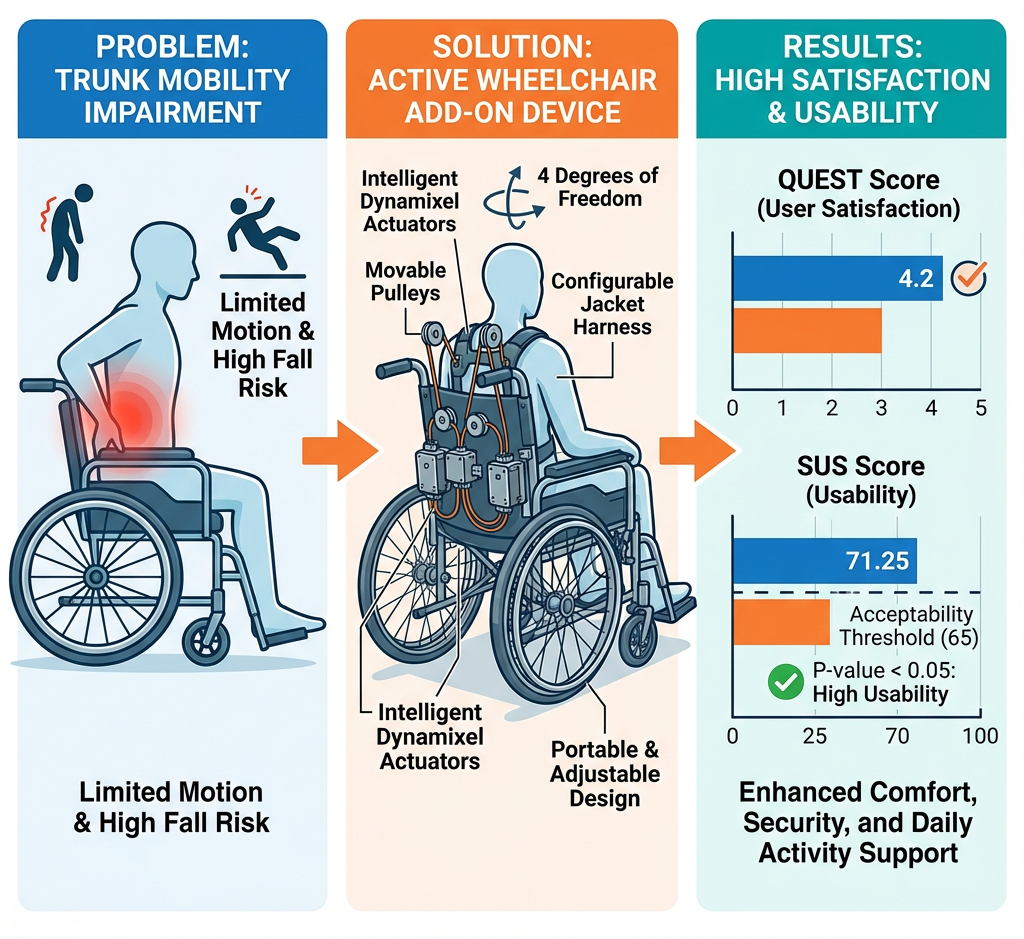
Background: Neurological, spinal, or age-related variables can cause trunk mobility impairments, which impair posture control and raise the risk of falls, both of which have an adverse effect on quality of life. Few active and passive trunk-assistive devices have been created to help these people, but their portability, range of motion, and customizability are limited. The aim of this study is to create and assess a novel, active trunk assistive technology that overcomes these constraints.
Methodology: An active wheelchair add-on device design was suggested using intelligent Dynamixel actuators. Its four degrees of freedom movement design comprised movable pulleys and a configurable jacket harness. Ten healthy participants (male: age 31.2 ± 6.55 years and female: age 26.5 ± 6.61 years) completed the Quebec User Evaluation of Satisfaction with Assistive Technology (QUEST) and System Usability Scale (SUS) questionnaires to provide feedback on the device's performance. Additionally, statistical analysis was used in order to further evaluate device usefulness.
Results: A high degree of user satisfaction is shown by the QUEST score of 4.2 ± 0.4 and the SUS mean score of 71.25 ± 7.84, with 7 participants exceeding the threshold of 65. P-value (0.041) < α (0.05) in one sample t-test on SUS scores indicated higher device usability than the acceptable score of 65. The outcomes confirm how well the design works in terms of convenience, comfort, and security.
Conclusion: The suggested design demonstrated the potential to enhance trunk mobility and support everyday activities for those with poor trunk control because of its increased range of motion, adjustable harness, and portability. It effectively addresses the shortcomings of the current trunk support devices.
Keywords: Assistive, Independence, Mobility, Neurological, Robotic, Trunk
To cite this article: Rao AZ, Mushtaq B, Ghauri GAK, Adeen R, Siddiqui MZ, Hasan MA. User Satisfaction and Functional Trunk Support Using a Robotic Assistive Device: A Pilot Study. Pakistan Journal of Rehabilitation. 2026; 15(1):19-25.
Downloads
Published
Issue
Section
License
Copyright (c) 2026 Pakistan Journal of Rehabilitation

This work is licensed under a Creative Commons Attribution 4.0 International License.


