Predictors of Foot Care Practices among Patients with Type 2 Diabetes Mellitus: A Cross-Sectional Study
Predictors of Diabetic Foot Care Practices
DOI:
https://doi.org/10.36283/pjr.zu.15.1/009Abstract
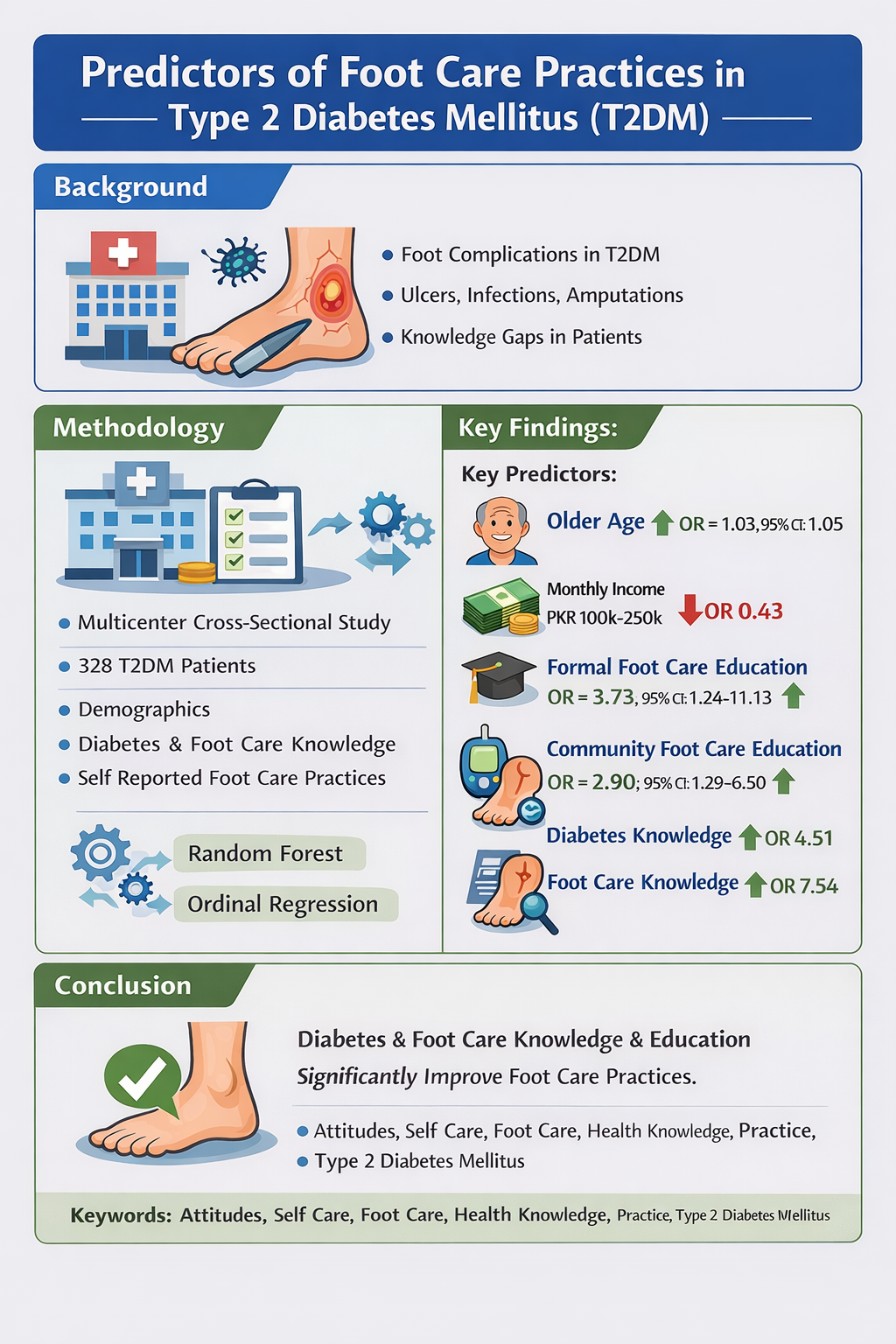
Background: Foot complications are a major cause of morbidity in Type 2 Diabetes Mellitus (T2DM), which often leads to ulcers, infections, and amputations. Despite the fact that most of the diabetic foot complications are preventable, gaps in patient understanding, awareness and education lead to suboptimal practices in foot care. This study investigated the knowledge and education-related predictors of foot care practices among patients with T2DM.
Methodology: A multi-center cross-sectional study was conducted on 328 individuals with T2DM, attending tertiary care hospitals in Karachi. The data collection involved a self-administered structured questionnaire, aimed at assessing demographics, educational exposure, diabetes knowledge, foot care knowledge and self-reported foot care practices. Random Forest algorithms were employed to select variables for ordinal regression to assess predictors for foot care practices.
Results: A total of 328 participants were included in the study. Better practices were predicted by older age (OR = 1.03; 95% CI: 1.01-1.05). Participants who had a monthly income of PKR 100,000 - 250,000 were less likely to have better practices as opposed to those with monthly income of PKR <100,000 (OR = 0.43; 95% CI: 0.20-0.93). Received formal foot care education was significantly associated with improved foot care practices (OR = 3.73; 95% CI: 1.24-11.13), as was community foot care education (OR = 2.90; 95% CI: 1.29-6.50). The knowledge of diabetes (OR = 4.51; 95% CI: 2.09-9.74), and foot care knowledge (OR = 7.54; 95% CI: 3.47-16.39) were the strongest predictors of improved foot care practices.
Conclusion: This study demonstrates that diabetes and foot care knowledge along with formal and community-based education are highly significant predictors of foot care practices in patients with T2DM showing the significance of targeted educational interventions to enhance preventive practices.
Keywords: Attitudes, Self-Care, Foot Care, Health Knowledge, Practice, Type 2 Diabetes Mellitus
To cite this article: Hussain S, Tajwar H, Khan R, Akber FA, Wasim S. Predictors of Foot Care Practices Among Patients with Type 2 Diabetes Mellitus: A Cross-Sectional Study. Pakistan Journal of Rehabilitation. 2026; 15(1):35-40.
Downloads
Published
Issue
Section
License
Copyright (c) 2026 Pakistan Journal of Rehabilitation

This work is licensed under a Creative Commons Attribution 4.0 International License.


