Association of Restless Legs Syndrome with Hypertension and its Complications: A Cross-Sectional Study
RLS, Hypertension, and Related Complications
DOI:
https://doi.org/10.36283/pjr.zu.15.1/007Abstract
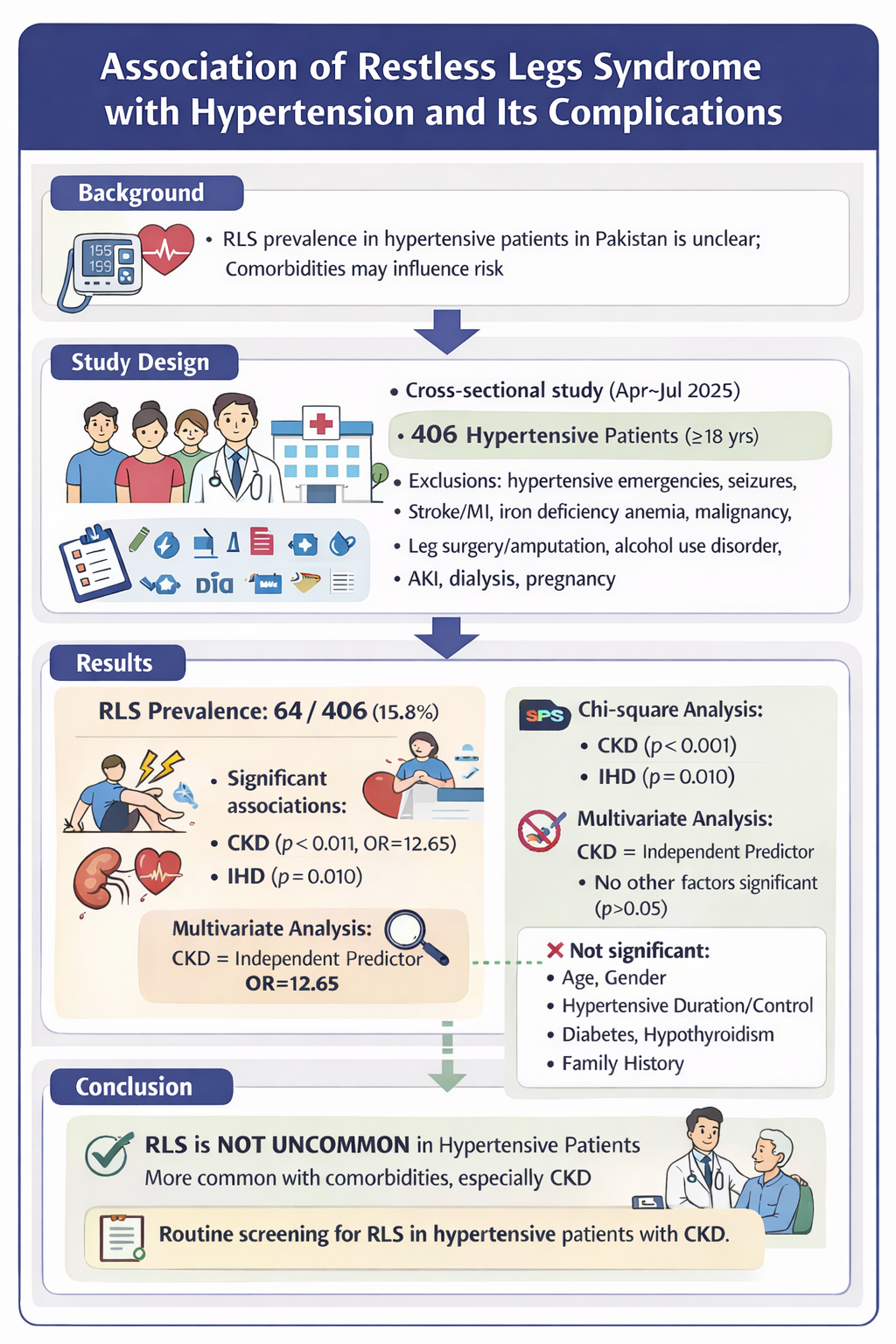
Background: Hypertension-associated complications and comorbidities continue to be widespread, although hypertension management has improved. Given the wide variability in the global frequency of Restless Legs Syndrome (RLS) in hypertensive patients and lack of data specific to Pakistan, where ethnic, healthcare and awareness differences limit the applicability of international findings, this study aims to determine the frequency of RLS in hypertensive individuals within the Pakistani population.
Methodology: This cross-sectional study was carried out from April to July 2025 at Departments of Medicine, Cardiology and Nephrology at Chaudhary Muhammad Akram Teaching and Research Hospital Lahore Pakistan. Using non-probability convenience sampling, 406 hypertensive patients aged ≥18 years were included. Patients were excluded if they had hypertensive emergencies, seizures, ongoing stroke or myocardial infarction, iron deficiency anemia, malignancies, a history of leg surgery or amputation, alcohol use disorder, acute kidney injury, were on hemodialysis or were pregnant. RLS was diagnosed according to the National Institutes of Health (NIH) criteria. Hypertension was defined as having blood pressure readings greater than 140/90 mm Hg on two separate occasions 2 weeks apart, ambulatory measurements exceeding 140/90 mm Hg at least 15 days apart, a prior diagnosis or antihypertensive medication use. Demographic information was collected and each participant underwent clinical evaluation to assess blood pressure control, antihypertensive treatment, comorbid conditions and the presence of RLS.
Results: Among the 406 patients, RLS was present in 64 (15.8%) patients. Post-stratification chi-square analysis showed that CKD (p<0.001) and IHD (p=0.010) had statistically significant associations. In multivariate logistic regression analysis, CKD emerged as a significant independent predictor of RLS (p<0.001, OR=12.649, 95% CI: 3.150–49.362). No other variables including gender, age, employment, marital status, hypertension duration or control, treatment regime, hypertensive retinopathy, diabetes, hypothyroidism or family history of hypertension had statistical significance.
Conclusion: Not an uncommon finding, RLS was more common with presence of co-morbid conditions in hypertensive patients. Routine screening for RLS, especially in hypertensive patients with CKD, may help improve patient outcomes.
Keywords: Restless Legs Syndrome, Hypertension, Chronic Kidney Disease, Hypertensive Retinopathy, Pakistan.
To cite this article: Waris B, Butt NI, Khizar I, Waris U, Baber A, Javed U. Association of Restless Legs Syndrome with Hypertension and its Complications: A Cross-Sectional Study. Pakistan Journal of Rehabilitation. 2026; 15(1):26-30.
Downloads
Published
Issue
Section
License
Copyright (c) 2026 Pakistan Journal of Rehabilitation

This work is licensed under a Creative Commons Attribution 4.0 International License.


